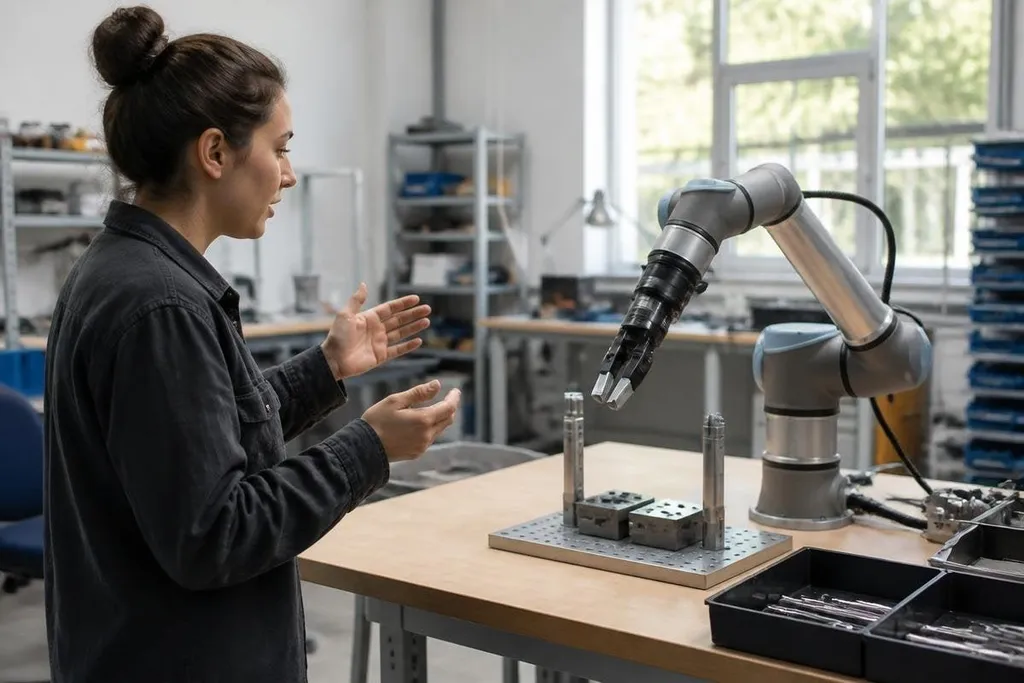
A robot arm can move to a fixed position with great accuracy, yet struggle when a person gives the task in ordinary speech. Language models are changing that interface by turning instructions into smaller actions a robot can check and run.
- Language models translate human requests into robot tasks.
- A second system still handles motion, sensing, and safety.
- The hard part is proving that the robot understood the task correctly.
What the language model adds
A language model works with words and patterns. A robot needs targets, limits, tool commands, and sensor checks. The useful link between them is a layer that turns a request into a plan the robot's software can inspect.
If you ask a robot to clear a workbench, the model might split that request into actions such as finding objects, sorting them, moving them to known locations, and checking the surface again. The model doesn't move the arm by itself. It calls skills that the robot already knows how to run.
That distinction matters. A language model can select “pick up,” “place,” or “open,” but a motion controller decides the joint angles, speed, and force. A camera or LiDAR sensor supplies information about the scene, while the controller handles the physical movement.
The model can also help when people use different words for the same task. “Put the tools away” needs more interpretation than “move the wrench to bin 2.” The robot still needs a defined storage rule, yet the person doesn't have to learn a command language first.
From words to motion
A working system usually links several parts. The language model reads the request, a planner turns it into steps, perception software checks the surroundings, and a controller sends commands to the motors. Each part has a different job, which limits the damage from a bad answer.
Some systems use a library of robot skills. A skill might open a drawer, follow a path, pick up a known object, or stop when a force sensor detects contact. The language model chooses among those skills and fills in details such as the object name or destination.
Other systems connect language with images and robot actions in one model. These systems aim to relate a sentence, what the camera sees, and the movement that should follow. They still need tests outside the training setting, because a familiar instruction can hide unusual lighting, object shapes, or blocked paths.
A spoken instruction can now describe a goal while the model chooses several robot actions. For a reader comparing demos with deployed systems, dated language-model robotics reports can tie that change to named machines, task results, and limits outside the lab.
Where the approach helps
Language models are useful when tasks change often or when a trained operator needs to give instructions without writing code. A technician could describe a new inspection sequence, then review the steps before the robot runs them.
The same interface can help a robot explain its next action. That matters when a machine stops because it cannot see an object, lacks permission to open a door, or finds two possible targets. A plain status message is easier to act on than a raw software error.
The limits are physical and practical. A model may choose a reasonable-sounding action that does not fit the robot's tools. It may misunderstand “clear the table” when some objects must stay in place.
A slow connection can also make a spoken interface unsuitable for tasks that need fast response.
Safety needs a separate control layer. The robot should check workspace limits, object weight, speed, and human presence before it carries out a plan. I'd trust a language model to suggest steps before I'd trust it to approve motor commands without those checks.
What teams need to build
A useful language interface starts with a narrow task set, clear robot skills, and records of failed actions. Teams also need a way to ask for confirmation when the request is unclear or the action could cause damage.
The quality of the result depends on the link between language and the physical scene. A model may know what a cup is, but the robot needs to find that cup, estimate its position, choose a grip, and check that the grasp worked.
This is why a polished conversation demo proves little on its own. The harder test is repeated work with changing objects, partial visibility, interruptions, and people nearby. Those conditions expose errors that a clean scripted scene can hide.
A practical check before deployment
Use these questions when judging a language-driven robot system:
- Defined skills: Can the model call a fixed list of tested robot actions?
- Scene checks: Does the robot confirm object location and identity before moving?
- Human approval: Can a person review risky or unclear plans?
- Failure handling: Does the system stop safely and explain what blocked it?
- Local control: Do speed, force, and workspace limits stay outside the model?
The next useful measure is not how naturally a robot answers a spoken request. It is how often the full system completes the right task, stops safely when the request is unclear, and gives a person enough information to fix the problem.